Research into new treatments for CHD boosted by funding awards

Two new grants will further BHI research into progeria and pulmonary hypertension:

MRC: Gene-inspired therapy to rescue cardiovascular disease in progeria: awarded to Professor Paolo Maddedu

Hutchinson-Gilford progeria syndrome (HGPS), characterised by a rapidly ageing appearance, is a rare disease caused by an abnormal gene and related protein. Because there is no effective cure, children with HGPS will, on average, die of cardiovascular disease at around 14 years old.

This project proposes a new treatment where a gene – found in people who live a long and healthy life – is transferred to rescue the premature cardiovascular senescence typical of HGPS patients.

Professor Paolo Madeddu’s team has discovered a beneficial variant of the BPIFB4 gene, and shown in animal models that transferring this gene reduces the suffering from a heart attack, diabetes and high blood pressure. Preliminary studies showed that the longevity BPIFB4 mutation can benefit some molecular mechanisms that are dysfunctional in children with HGPS.

Paolo says:

“We will determine the efficacy of BPIFB4 gene therapy in HGPS mice, looking at the treatment’s ability to preserve heart and blood vessel function. In addition, we will investigate the mechanisms underpinning this benefit, using human cells from HGPS patients. If results are positive, we will continue our research confirming the lack of toxicity, defining the best dose and timing of treatment for prolonged benefit and the advantage of adding BPIFB4 therapy to current drugs, in view of obtaining permission for a clinical study in patients.”


HRUK: Targeting
pericytes for halting pulmonary hypertension in infants with CHD: awarded to Professor Paolo Madeddu, Professor Massimo Caputo and Dr Elisa Avolio

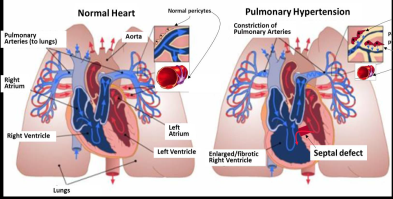
 Some children are born with a ventricular septal defect: a hole in the wall between the two lower chambers of the heart, where blood can flow across the hole from the left side of the heart to the right. If the defect is not corrected in time, children are likely to develop pulmonary hypertension (high pressure in the blood circulation to the lung).

Surgical correction of the ventricular shunt usually allows the blood pressure in the lungs to return to normal levels. In some cases, however, the pressure may stay higher than normal after surgery.

At least five to 10 per cent of patients with congenital heart disease develop pulmonary arterial hypertension (PAH), which can lead to heart failure. The risk of developing pulmonary hypertension is higher for children living in poor countries and areas of social deprivation, because of the limited access to specialist centres where the cardiac defect can be recognised and corrected before complications arise.

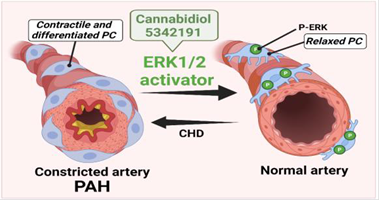
Recent research indicates pericytes – multi-functional cells embedded within the walls of capillaries – could be targeted for the treatment of PAH. Paolo says:

“Our research will investigate why pericytes from children with CHD constrict and block the pulmonary circulation. It will also test a new treatment to reduce the contraction of pulmonary pericytes and prevent pulmonary hypertension occurring.”
Fostering collaboration and supporting early career researchers

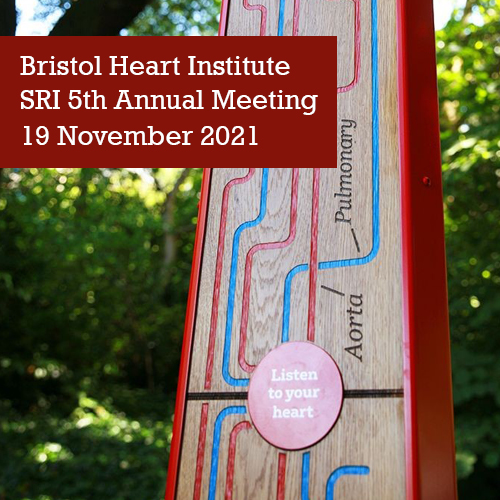
Bristol Heart Institute installation in Royal fort Gardens, Bristol

Eighty Bristol Heart Institute researchers joined ‘Fostering collaboration and supporting early career researchers’, our 5th Annual Meeting on 19 November 2021. The day was an opportunity not only to get to know some of the research taking place in the University’s Specialist Research Institute, but also the researchers driving it forward.

BHI researcher talks

In the first session on cardiac surgery, Massimo Caputo looked at tissue engineering, combining surgical facilities and imaging technologies in ‘hybrid’ theatre, cardiac 3D printing to help plan operations and how advances in VR technology are taking this to the next level.

Next, Tom Johnson, Consultant Cardiologist and recently appointed Associate Professor, examined a range of cardiovascular research priorities, from intracoronary imaging to industry collaboration, AV Cath lab broadcasting to encourage collaboration and the potential for system-wide datasets to enhance patient outcomes.

Jules Hancox from the School of Physiology, Pharmacology and Neuroscience shared some thoughts on career progression for early career researchers, including memorable advice about choosing a research project: “Interesting is not equivalent to important” – a trap that all researchers fall into from time to time, he acknowledged!

To wrap up the morning’s talks, Deborah Lawlor discussed Bristol’s epidemiological research in the BHI.

Plenary

For the plenary we welcomed Professor Andrew Taylor, Director of Innovation at Great Ormond Street Hospital and Head of Cardiovascular Imaging at UCL Institute of Cardiovascular Science, to talk about innovating in cardiovascular research. Using examples such as fast imaging protocols and the potential for delivering precision medicine via AI, he looked at why putting innovations into clinical practice at pace remains challenging, and how ongoing interaction between researchers and clinical teams is vital.

Quickfire presentations

BHI PhD students and early career researchers were invited to present their work in five minutes in three themed sessions covering epidemiology, basic science and clinical research. Attendees voted for the best presentation in each session – well done to:

  • Lucy Goudswaard: “Combining Mendelian randomisation and randomised control trial study designs to determine effects of adiposity on the plasma proteome”
  • Stanley Buffonge: “The battle to protect the coronary microvascular endothelial glycocalyx in diabetes”
  • Monica Gamez: “Endothelial glycocalyx heparan sulfate contributes to the integrity of the blood-retina-barrier and can be therapeutically targeted in diabetes mellitus”

Thank you

Thanks to everyone who took part in the meeting and especially to the organising committee, without whom the day wouldn’t have been possible: Alexander Carpenter, Alba Fernandez-Sanles, Laura Pannell, Eva Sammut and Andrew Shearn, along with Giovanni Biglino and Stuart Mundell.

Laura says:

“It was a fantastic day showcasing research the BHI can be proud of, and will enable the development of collaborative relationships for many years to come!”